AI in Software Development 2026: Trends, Benefits & Use Cases

AI in Software Development 2026

AI in Software Development 2026 is transforming how applications are built, tested, and deployed using AI tools and automation. The software development industry in 2026 is undergoing a massive transformation, driven by the rapid rise of artificial intelligence and automation. What once required extensive manual effort, large development teams, and long timelines can now be achieved in a fraction of the time. Intelligent systems are enabling developers to build faster, smarter, and more efficient applications. Businesses are no longer adopting these technologies just for innovation—they are using them as essential tools to stay competitive in a digital-first world.

Artificial intelligence is redefining how software is built from the ground up. Developers today rely heavily on AI-powered tools that assist in writing code, identifying bugs, and suggesting improvements in real time. This shift is not only increasing productivity but also reducing human error significantly. As a result, development teams can focus more on solving complex business challenges rather than spending time on repetitive tasks. AI is also enhancing user experiences through intelligent chatbots, recommendation systems, and predictive features that are becoming standard in modern applications.

At the same time, automation is reshaping the entire software development lifecycle. From testing and deployment to infrastructure management, processes that once required manual intervention are now handled through advanced automation pipelines. Continuous integration and continuous deployment (CI/CD) have become essential practices, allowing businesses to release updates faster while maintaining stability and performance. This level of automation is especially valuable for companies looking to scale rapidly without compromising quality.

Another major trend shaping 2026 is the rise of low-code and no-code platforms. These tools are empowering businesses and non-technical users to build applications with minimal coding knowledge. While traditional development remains critical for complex systems, these platforms are accelerating innovation and enabling faster prototyping. Alongside this, cloud-native development continues to dominate, offering scalability, flexibility, and cost-efficiency for businesses of all sizes.

Microservices architecture is also gaining strong momentum. Instead of building large monolithic applications, developers are shifting toward smaller, independent services that can be updated, scaled, and maintained more efficiently. This modular approach aligns perfectly with automation and cloud technologies, allowing businesses to grow without technical limitations.


AI in Software Development 2026 Trends

Several key trends are driving the future of software development, and understanding them is essential for any business planning long-term growth.

  • AI-powered development tools are reducing coding time and improving accuracy
  • Low-code and no-code platforms are enabling faster application development
  • Cloud-native applications are becoming the standard for scalability
  • Microservices architecture is replacing traditional monolithic systems
  • DevOps automation is streamlining development and deployment processes

These trends are not just technical improvements—they are strategic advantages that help businesses innovate faster and operate more efficiently.


Advantages of AI in Software Development 2026

From a business perspective, adopting AI with AI in software development 2026, businesses can scale faster, and automation offers significant benefits. Companies adopting AI in software development in 2026 gain a competitive advantage. Faster deployment cycles allow businesses to respond quickly to market demands, while automation reduces operational costs. Additionally, AI-driven features enhance user engagement and personalization, leading to improved customer satisfaction and retention.

Key advantages include:

  • Faster development cycles and quicker time-to-market
  • Reduced operational and development costs
  • Improved accuracy with fewer errors
  • Better scalability through cloud and microservices
  • Enhanced user experience with intelligent features

Challenges & Limitations

Despite its advantages, implementing AI and automation comes with certain challenges. Businesses must invest in the right tools, infrastructure, and skilled professionals. There is also a risk of over-reliance on automated systems, which can limit human creativity if not properly balanced. Security and data privacy are additional concerns, especially when working with AI-driven systems that rely heavily on data.

Common challenges include:

  • Initial setup and integration complexity
  • Need for experienced AI professionals
  • Security and data privacy risks
  • Continuous updates and maintenance
  • Risk of over-automation

Understanding these limitations helps businesses make smarter, more informed decisions.


Real-World Use Cases

AI and automation are already delivering measurable results across industries. E-commerce platforms use AI to recommend products and increase conversions, while businesses deploy chatbots to provide instant customer support. Development teams rely on automated testing tools to ensure bug-free releases, and smart dashboards provide real-time insights for better decision-making. These real-world applications highlight how AI is not just a trend but a powerful solution driving real business value.


Why Businesses Should Act Now

In today’s competitive landscape, adopting AI and automation is no longer optional. Companies that embrace these technologies early gain a significant advantage by delivering faster, smarter, and more reliable solutions. Businesses that delay adoption risk falling behind as customer expectations continue to evolve.

AI enables better decision-making, improves operational efficiency, and enhances customer engagement. It allows organizations to shift from reactive strategies to proactive innovation, which is essential for long-term success.


How Codmash Helps Businesses

At Codmash, we specialize in implementing modern, AI-driven development solutions tailored to business needs. Whether it’s building high-performance WordPress websites, optimizing Shopify stores, or developing custom applications with automation, our focus is on delivering scalable and future-ready digital products.

We combine technical expertise with business strategy to ensure that every solution drives real results.

Explore our WordPress & Shopify development services to build scalable AI-powered solutions.


Conclusion

The future of software development in 2026 is being shaped by artificial intelligence and automation. These technologies are transforming how applications are built, deployed, and scaled, offering businesses new opportunities for growth and efficiency. While there are challenges to consider, the advantages far outweigh the limitations for organizations willing to adapt.

If you are looking to upgrade your digital presence or integrate AI into your business, now is the perfect time to take action. The future is already here—and those who embrace it early will lead the way.


📞 Call to Action

If you are ready to integrate AI and automation into your business, now is the perfect time to start.

Contact us today for a free consultation and discover how we can help you build future-ready software solutions.
What is AI in software development 2026?

AI in software development 2026 refers to using AI tools to automate coding, testing, and deployment, making development faster and more efficient.

How does automation help software development?

Automation reduces manual work, speeds up deployment, and improves consistency through CI/CD pipelines.

What are the main benefits of AI in development?

AI helps reduce costs, improve accuracy, increase speed, and enhance user experience.

Will AI replace developers?

No, AI supports developers by handling repetitive tasks while developers focus on complex problem-solving.

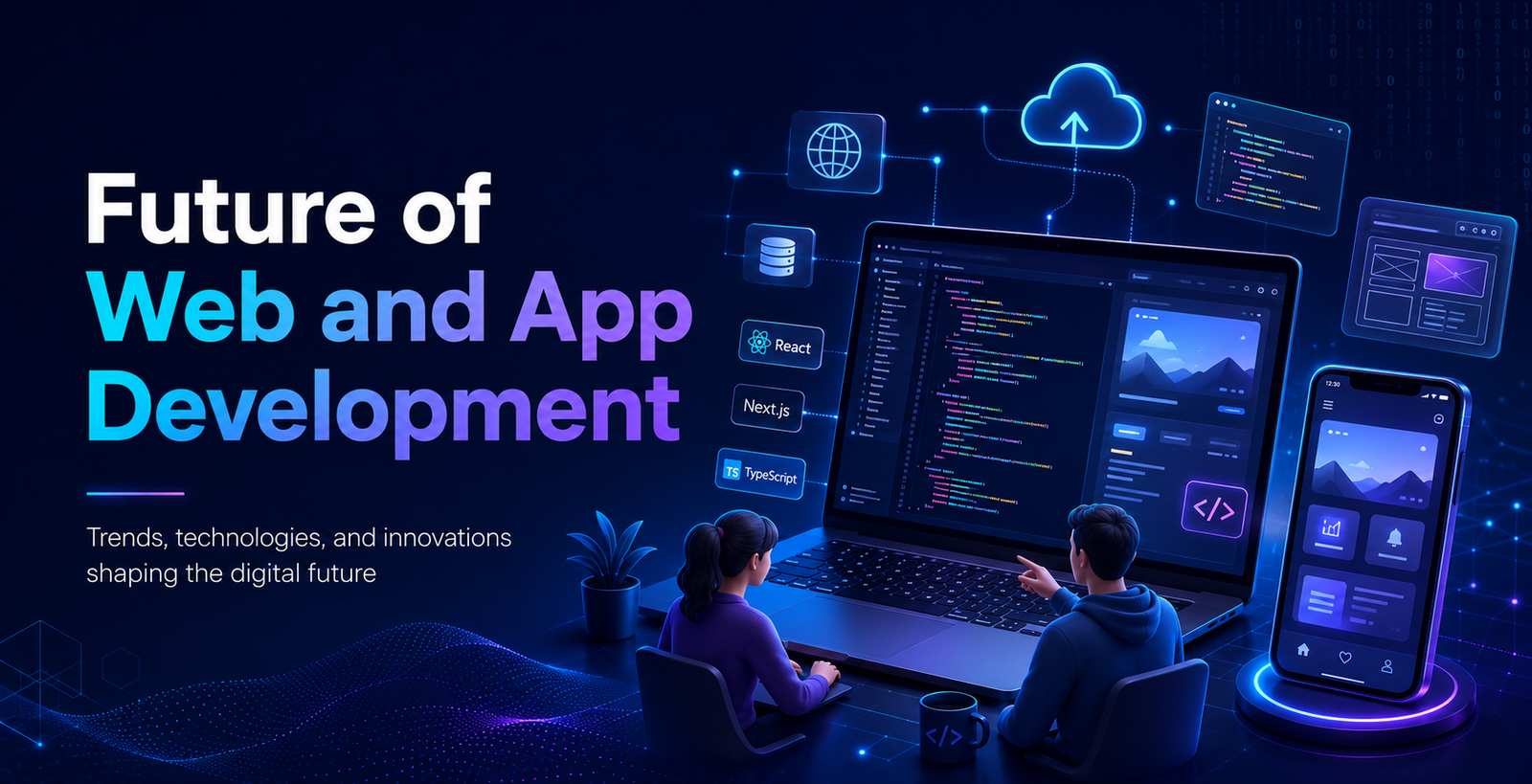
The Future of Web and App Development: Building Digital Platforms That Grow With Your Business

As businesses step into a new era of digital growth, understanding the future of web and app development has become essential for long-term success. Technology is no longer just a support system—it is a strategic asset that shapes customer experience, brand credibility, and scalability. At CodMash, we help businesses prepare for the future by building digital platforms designed to evolve, perform, and scale with changing market demands.

The future of web and app development is not defined by short-lived trends. Instead, it is driven by intelligent systems, performance-focused architecture, and user-centric design that delivers real business value over time.


How the Future of Web and App Development Is Evolving

The future of web and app development is moving toward platforms that are smarter, faster, and more adaptive. Businesses are shifting away from rigid systems and investing in flexible architectures that support innovation without constant rebuilding. Modern platforms are designed to learn from user behavior, integrate advanced technologies, and adapt to growth effortlessly.

CodMash approaches development with a future-first mindset, ensuring every solution is built to support long-term expansion rather than short-term fixes.


Intelligent and Adaptive Digital Experiences

Artificial intelligence is playing a central role in shaping the future of web and app development. Future-ready platforms will use intelligent automation to personalize user journeys, streamline operations, and deliver relevant content at the right time. These capabilities help businesses improve engagement while reducing operational overhead.

At CodMash, we integrate intelligent features strategically, ensuring they align with business goals and enhance user experience without adding unnecessary complexity.


Performance as a Core Foundation for Future Growth

Performance remains a critical pillar in the future of web and app development. Search engines continue to prioritize fast-loading, stable, and mobile-optimized platforms. Users expect seamless experiences across devices, regardless of traffic volume or data complexity.

Future-focused development emphasizes optimized codebases, scalable infrastructure, and cloud-ready solutions. CodMash builds performance-driven platforms that maintain speed, reliability, and SEO strength as businesses grow.


User Experience That Builds Long-Term Trust

The future of web and app development places strong emphasis on user experience and interface clarity. Instead of visual trends, the focus is on usability, accessibility, and intuitive navigation. Digital products must guide users naturally, reduce friction, and build confidence at every interaction point.

CodMash designs interfaces that balance simplicity with functionality, ensuring digital experiences remain relevant and effective as user expectations evolve.


Security and Reliability in the Future Digital Landscape

Security is a defining factor in the future of web and app development. As platforms become more interconnected, protecting user data and system integrity is critical. Businesses that prioritize secure development practices build lasting trust and ensure compliance with evolving regulations.

CodMash follows a security-first development approach, embedding protection mechanisms throughout the development lifecycle to support safe and reliable digital growth.


Preparing Your Business for the Future of Web and App Development

Preparing for the future of web and app development requires strategic planning, not reactive decisions. Businesses that invest in scalable infrastructure, intelligent systems, and performance optimization today will be better positioned for tomorrow’s challenges.

CodMash partners with businesses to create digital solutions that are adaptable, secure, and aligned with long-term business objectives. By focusing on the future rather than temporary trends, we help brands build platforms that deliver sustained value.

Frequently Asked Questions About the Future of Web & App Development

How does the future of web and app development impact growing businesses?

The future of web and app development focuses on scalability, performance, and adaptability. Growing businesses benefit from platforms that can handle increasing users, integrate new technologies, and evolve without frequent rebuilds. This approach supports long-term growth and reduces technical debt.

Why should businesses invest in future-ready web development services?

Investing in future-ready web development helps businesses stay competitive, improve search visibility, and adapt quickly to market changes. Platforms built with modern architecture perform better, rank higher on search engines, and deliver a smoother user experience.

Is future-focused web development suitable for startups and small businesses?

Yes, future-focused development is especially valuable for startups and small businesses. Building a scalable and secure foundation early prevents costly redesigns later and supports faster growth as business needs expand.

How does CodMash support digital transformation for businesses in India and globally?

CodMash provides end-to-end digital transformation services, including custom web development, mobile app development, UI/UX design, and performance optimization. We work with clients in India and internationally, delivering solutions aligned with global standards and local business needs.

Can existing websites be upgraded for future scalability?

In many cases, existing websites can be modernized instead of rebuilt. Performance optimization, code refactoring, and cloud-based enhancements allow businesses to upgrade their platforms while preserving existing data and functionality.

What industries benefit most from future-ready web and app development?

Industries such as e-commerce, SaaS, healthcare, fintech, real estate, and service-based businesses benefit significantly from future-ready digital platforms. Scalable systems allow these industries to handle growth, security requirements, and evolving customer expectations.

How long does it take to build a future-ready web or mobile application?

Project timelines depend on complexity, features, and integrations. A strategic discovery phase helps define requirements clearly, ensuring efficient development and a platform that supports long-term business goals.

How Generative Engine Optimization (GEO) is Revolutionizing SEO in 2025

Illustration of AI-driven search engine generating content summaries, representing Generative Engine Optimization (GEO) in 2025.

The search landscape has never stood still, but the shift happening in 2025 feels like a revolution. For more than two decades, businesses have optimized their websites to rank on search engine results pages — the familiar list of blue links. However, the arrival of Generative AI search models, such as Google’s AI Overviews, Microsoft Copilot Search, and OpenAI’s ChatGPT Browse, has rewritten the rules. Users are no longer clicking through ten links; they’re reading curated, AI-generated summaries.

This fundamental change is what has given rise to Generative Engine Optimization (GEO) — a new layer of SEO that focuses not just on ranking, but on being trusted, cited, and included within AI-generated answers.

At Codmash Technologies, we’ve watched this evolution unfold closely. Traditional SEO techniques like keyword density, backlink chasing, and metadata optimization remain relevant, but GEO demands something deeper — authority, structure, and contextual accuracy that AI systems can understand and verify.

What Exactly Is Generative Engine Optimization?

The Revolutionary Evolution of Generative Engine Optimization (GEO) is the process of optimizing your digital content for AI-driven search engines and generative response systems. Instead of targeting how search engines rank pages, GEO focuses on how AI interprets, summarizes, and synthesizes information from multiple sources.

In a traditional SEO model, your goal is to appear on the Explore our detailed guide first page of Google. In a GEO model, your goal is to be one of the sources that an AI trusts enough to include in its summary. The difference may seem subtle, but it completely changes the approach to digital content creation.

GEO emphasizes semantic clarity, content structure, fact reliability, and brand reputation. It’s about training the algorithms to recognize your business as a credible authority within your niche — not just for humans, but for machines learning to read like humans.

Why GEO Matters More Than Ever in 2025: The Future of Search Visibility

The Future of Search: Generative Engine Optimization (AI) In 2025, generative engines are not just assisting search — they are the search. Users ask natural questions, and AI models instantly synthesize insights from multiple verified sources to deliver a single, concise answer.

This means that the number of clicks from traditional organic listings is declining. If your business isn’t part of that synthesized response, your visibility shrinks dramatically. GEO ensures that your content is structured, factual, and cited in a way that AI models prefer.

Moreover, Google, Bing, and even emerging decentralized search platforms are increasingly rewarding structured, data-rich, expert-written content. GEO leverages schema, semantic markup, author authority, and factual integrity to make your website recognizable in this new search landscape.

How GEO Differs from Traditional SEO

Traditional SEO has always been about keywords, backlinks, and on-page optimization. GEO builds on these fundamentals but introduces new dimensions.

Where SEO asks, “What will help me rank?”, GEO asks, “What will help the AI trust my content enough to quote it?”

Search engines have evolved into generative systems capable of understanding context and intent rather than just counting keywords. GEO’s primary differentiator lies in content credibility and structure. For example, long-form blogs written with clarity, verifiable data, and internal linking now have a much higher chance of being picked up by AI summaries than keyword-stuffed posts.

In GEO, even your content’s formatting matters — the presence of headings that clearly segment ideas, the use of cited statistics, and the existence of author bios all feed into how AI evaluates your domain’s expertise and reliability.

The Core Principles of GEO

Generative Engine Optimization is not a replacement for SEO but rather an evolution. It’s about aligning your content with how modern AI models interpret information. The foundation of GEO rests on four principles: authority, structure, accuracy, and authenticity.

Authority comes from consistent, high-quality publishing across a focused niche. Generative models prefer sources that show depth in a specific domain rather than broad, shallow coverage.

Structure refers to how information is presented. AI systems understand well-structured text far better than unorganized prose. Clear sections, subheadings, and contextually connected paragraphs help models extract accurate meaning.

Accuracy is crucial in a world where misinformation spreads fast. Generative engines rely heavily on cross-verification. A single incorrect fact can disqualify your content from being used in AI responses.

Authenticity means original insight, tone, and real authorship. With AI-generated spam increasing daily, genuine human commentary, supported by data and experience, stands out dramatically.

These principles define how successful digital brands will perform in the next phase of search evolution.

How to Optimize Content for Generative Engines

Implementing GEO starts with mindset. Instead of asking how to beat the algorithm, GEO asks how to assist it. This shift toward collaboration with AI-driven systems creates a more sustainable and long-term digital presence.

The first step is to build topic authority. Focus your content strategy around well-defined themes instead of scattering topics across unrelated categories. When your domain consistently discusses certain areas — for example, “AI in business operations” or “cloud infrastructure automation” — generative engines begin to associate your brand with subject expertise.

Next, ensure clarity and factual reliability. Use verifiable data, cite official sources, and link to recognized industry publications. Avoid clickbait titles or speculative statements without support. AI systems trained on massive datasets can detect inconsistencies remarkably fast.

Structured data markup (such as FAQ schema, How-To schema, and author profiles) enhances machine readability. It’s not just for Google; generative models also rely on structured metadata to understand context.

Finally, integrate authoritative voices into your content. Include expert quotes, research-backed insights, or commentary from real professionals within your organization. GEO rewards genuine human expertise that algorithms can associate with credible entities.

How AI Models Evaluate GEO Content

Generative engines are powered by neural networks that prioritize trust and coherence. When AI generates an answer, it doesn’t just pull text — it synthesizes, validates, and composes.

These systems assign a trust score to every data source. This score depends on factual reliability, historical consistency, and reputation across the web. Sites that regularly update information, maintain strong domain health, and receive citations from other high-trust websites tend to score higher.

Another critical factor is contextual understanding. AI models prefer content written with narrative flow, logical sequencing, and connected ideas. This makes paragraph-based blogs — like this one — far more valuable than fragmented or bulleted content.

In 2025, we’re seeing models increasingly reward experience-based writing. Articles that demonstrate real-world expertise, such as insights from company projects or industry challenges, outperform purely informational blogs.

At Codmash Technologies, our approach to GEO aligns with this idea — we believe the human experience behind the content is the key differentiator in an AI-driven ecosystem.

Case Study: The Shift from SEO to GEO in Practice

Consider a technology consultancy publishing a weekly blog about cloud migration and infrastructure automation. Two years ago, their traffic strategy relied heavily on keyword targeting and backlinks. But by 2025, organic clicks dropped, even though their rankings hadn’t changed much.

After implementing GEO strategies — optimizing for schema, rewriting content with clearer topic authority, and publishing verified statistics — they noticed a new trend. Their brand started appearing in AI-generated overviews and assistant answers. Even though traditional impressions were lower, engagement rates doubled, and referral leads came directly from conversational search experiences.

This example highlights how success in 2025 is no longer just about visibility on page one. It’s about being part of the AI conversation.

Challenges and Misconceptions About GEO

Many companies rush into GEO believing it’s simply the next SEO checklist. But Generative Engine Optimization is less about tricks and more about content philosophy. The challenge lies in balancing human storytelling with machine readability.

A common misconception is that GEO requires abandoning traditional SEO. In truth, both coexist. Technical SEO remains vital — site speed, structured markup, mobile optimization, and link architecture are still part of the foundation. GEO builds upon this base, extending optimization toward contextual trust and content depth.

Another challenge is keeping content fresh and verifiable. AI engines continuously crawl the web for updates. Outdated or unmaintained pages lose authority quickly, so a long-term GEO strategy must include regular audits, content refreshes, and citation updates.

The Future of Search and the Role of GEO

As generative engines mature, the internet is shifting from a search-based model to a conversation-based model. Instead of typing keywords, users ask complex, natural questions. AI models analyze intent, summarize context, and deliver insights — effectively transforming how people discover information.

In this world, GEO isn’t just an optimization technique; it’s a communication strategy. Brands that align their messaging with AI logic will dominate visibility, while those clinging to old metrics risk fading away.

By 2027, analysts predict that nearly 70% of online searches will happen through generative engines or conversational interfaces. That means your website must evolve into a data-verified knowledge hub that AI trusts.

For IT and marketing firms, this is both a challenge and an opportunity. Businesses that master GEO today will lead tomorrow’s digital landscape.

How Codmash Technologies Implements GEO for Clients

At Codmash Technologies, we view Generative Engine Optimization as an essential part of modern digital transformation. Our approach combines AI content strategy, semantic SEO, and technical optimization to help businesses thrive in an AI-first search ecosystem.

We begin with a detailed content audit to identify which assets are visible to generative models and which need restructuring. Next, we integrate schema markup, improve factual alignment, and enhance topical consistency. Finally, we develop long-form, authoritative content — not just for ranking, but for trust-building with AI systems.

Our mission is to help organizations future-proof their online visibility. GEO isn’t a trend — it’s the new baseline for digital marketing success.

FAQs: Generative Engine Optimization in 2025

What is Generative Engine Optimization?
It’s the process of optimizing your content for AI-driven search systems that generate summarized responses instead of traditional link-based results.

Is GEO replacing SEO completely?
No. GEO builds upon SEO, focusing more on AI interpretation, trust signals, and factual clarity rather than ranking mechanics alone.

How can I make my website GEO-ready?
Focus on topic authority, data-backed accuracy, structured content, and strong author credibility. Use schema and maintain content freshness.

Why is GEO important for businesses in 2025?
Because most search queries are now answered by generative systems. Without GEO, your content might never appear in AI-generated responses.

Does GEO require advanced AI tools?
Not necessarily. It starts with a strong SEO foundation, enhanced with semantic optimization, structured data, and authentic human insights.

Conclusion

Generative Engine Optimization represents the next great leap in digital visibility. As AI continues to redefine how we access information, businesses that understand GEO will be the ones appearing inside those generative summaries — trusted, cited, and visible at the moment of intent.

At Codmash Technologies, we help brands transition seamlessly into this new era of search. Whether you’re optimizing your website, refining your content strategy, or planning for future AI visibility, GEO ensures your voice remains part of the digital conversation.

If your business is ready to evolve beyond traditional SEO and embrace the future of intelligent discovery, now is the time to start.

Unlocking Digital Success: Top IT Trends Shaping 2025

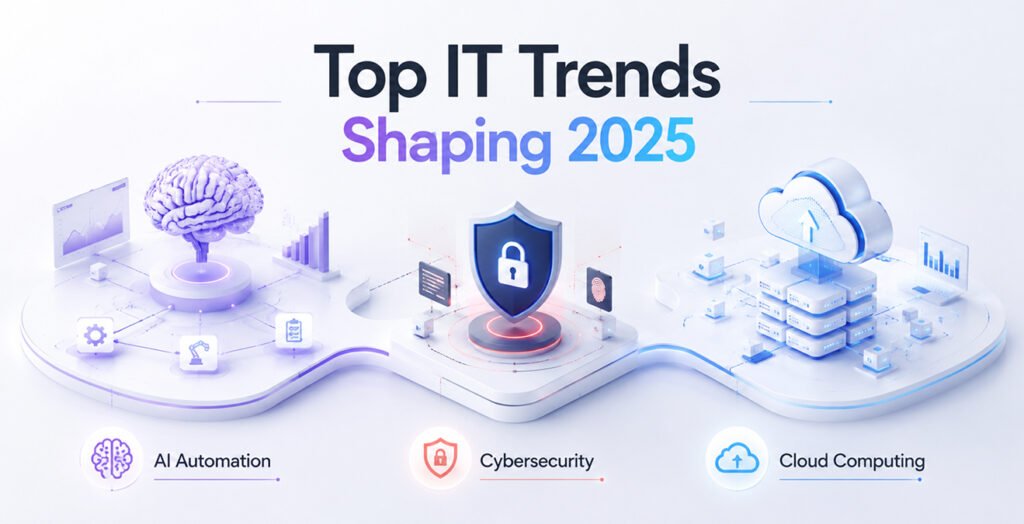
In today’s rapidly IT Trends evolving digital landscape, businesses must stay ahead of technological advancements to remain competitive. With AI-driven tools revolutionizing operations, decision-making, and customer experiences, companies now have the ability to analyze large datasets, automate processes, and gain actionable insights like never before. The year 2025 promises a host of innovations that are set to redefine industries, streamline operations, and transform customer experiences. Companies that proactively embrace these trends, including AI technology, can gain a significant advantage, driving both growth and innovation while improving user satisfaction.

This comprehensive guide explores the most impactful IT trends of 2025 and provides insights on how businesses can harness these technologies effectively.

AR and VR

AI-Driven Automation: Transforming Business Operations

Artificial Intelligence (AI) has emerged as a cornerstone of modern business strategies. Its ability to automate repetitive tasks, analyze large datasets, and provide actionable insights makes it indispensable. AI-driven solutions are transforming customer engagement through chatbots and virtual assistants that offer round-the-clock support, personalized recommendations, and instant responses. Brands such as Sephora and H&M have successfully deployed AI chatbots to enhance customer experiences and increase engagement.

Beyond customer service, AI enables predictive analytics, helping businesses anticipate market trends, optimize marketing campaigns, and uncover growth opportunities. In finance and human resources, AI automates routine processes such as payroll, invoice management, and onboarding, allowing employees to focus on higher-value tasks.

By leveraging AI, businesses can achieve operational efficiency, reduce costs, and make data-driven decisions that foster growth. Companies that fail to adopt AI risk falling behind competitors who are already using these tools to gain a strategic advantage.

Cybersecurity: Protecting Digital Assets

Cybersecurity remains a critical concern as cyberattacks become more sophisticated and frequent. With global cybercrime projected to reach over $10 trillion annually by 2025, organizations must invest in advanced security measures to protect sensitive data and maintain trust.

Modern cybersecurity strategies include zero-trust architecture, AI-powered threat detection, and compliance with regulations like GDPR and CCPA. AI systems can monitor networks in real time, identifying anomalies and preventing potential breaches before they cause damage. Businesses are also increasingly encrypting sensitive data and conducting regular security audits to ensure system integrity.

Companies like Microsoft and IBM are leading the development of AI-driven cybersecurity solutions that proactively mitigate threats. Effective cybersecurity not only protects digital assets but also safeguards a company’s reputation, which is vital for maintaining customer confidence.

Cloud Computing: Scalability and Flexibility

Cloud computing has transformed business infrastructure, offering scalable, flexible, and cost-effective solutions. By shifting from on-premises servers to cloud platforms, companies can reduce overhead costs while improving operational efficiency. Cloud computing enables real-time collaboration, facilitates remote work, and supports business continuity through robust backup and disaster recovery solutions.

SaaS platforms such as Salesforce and Slack allow teams to collaborate seamlessly across locations, while IaaS providers like AWS, Azure, and Google Cloud offer scalable computing resources. Businesses can launch applications quickly, scale resources on demand, and access critical data from anywhere, empowering them to respond faster to market changes.

Cloud computing also supports hybrid work environments, enabling organizations to maintain productivity and flexibility. By adopting cloud solutions, businesses gain the agility needed to innovate and compete in an increasingly digital world.

5G Connectivity: Powering Next-Generation Services

5G technology is transforming connectivity, delivering ultra-fast speeds, low latency, and high network capacity. Unlike previous generations, 5G supports real-time applications such as autonomous vehicles, smart cities, and IoT devices, creating new opportunities for innovation.

In healthcare, 5G enables remote surgeries and telemedicine by providing stable, low-latency connections. Smart cities leverage 5G to monitor traffic, energy consumption, and emergency services in real time, improving efficiency and sustainability. Autonomous vehicles rely on instant data transfer from sensors and infrastructure, enhancing safety and performance.

For businesses, 5G accelerates content delivery, improves collaboration, and enables immersive experiences through AR and VR applications. Early adoption of 5G technology positions companies as forward-thinking leaders, ready to capitalize on the next wave of digital innovation.

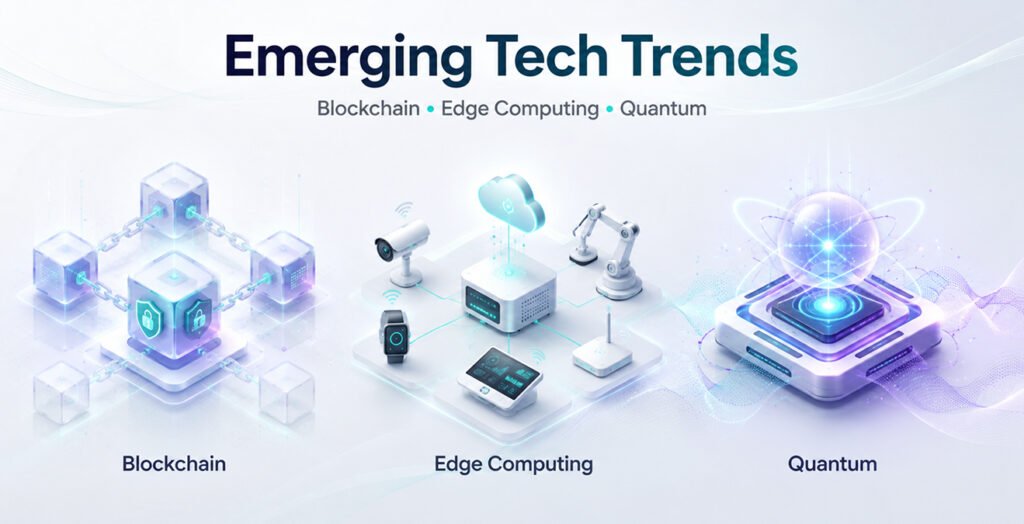
Blockchain Technology: Ensuring Transparency and Security

Blockchain has evolved beyond cryptocurrencies to provide secure, transparent, and efficient solutions for various industries. Its decentralized ledger system guarantees data integrity, reduces fraud, and enhances trust in digital transactions.

In supply chain management, companies like Walmart use blockchain to track products from origin to store, ensuring quality and accountability. In healthcare, blockchain secures patient records, allowing only authorized personnel to access sensitive data. Financial institutions utilize blockchain for faster, more secure cross-border transactions, reducing costs and settlement times.

Adopting blockchain technology improves transparency, operational efficiency, and security. It also helps companies build trust with clients, partners, and stakeholders, positioning them as reliable and innovative market leaders.

Edge Computing: Real-Time Processing at the Source

Edge computing processes data closer to the source, reducing latency and bandwidth usage while enabling faster decision-making. This technology is particularly beneficial for applications that require real-time responses, such as autonomous vehicles, industrial automation, and retail analytics.

In manufacturing, sensors monitor equipment to predict maintenance needs, preventing costly downtime. Retailers use edge computing to analyze shopper behavior instantly, optimizing layouts and product placement. Autonomous vehicles rely on edge computing to process onboard sensor data for safe navigation.

By combining edge and cloud computing, businesses can achieve a hybrid model that balances speed, scalability, and security, empowering them to innovate while maintaining operational efficiency.

Quantum Computing: Unlocking Advanced Problem-Solving

Quantum computing uses qubits to perform complex calculations far beyond the capabilities of classical computers. Industries such as pharmaceuticals, finance, and logistics are exploring quantum computing for optimization, simulation, and predictive modeling.

Quantum algorithms accelerate drug discovery, reduce research timelines, and optimize logistics operations by analyzing vast datasets. Financial institutions use quantum computing to manage risks, forecast market trends, and optimize portfolios efficiently. Although still in its early stages, businesses that invest in quantum solutions now are likely to gain a significant competitive advantage in the near future.

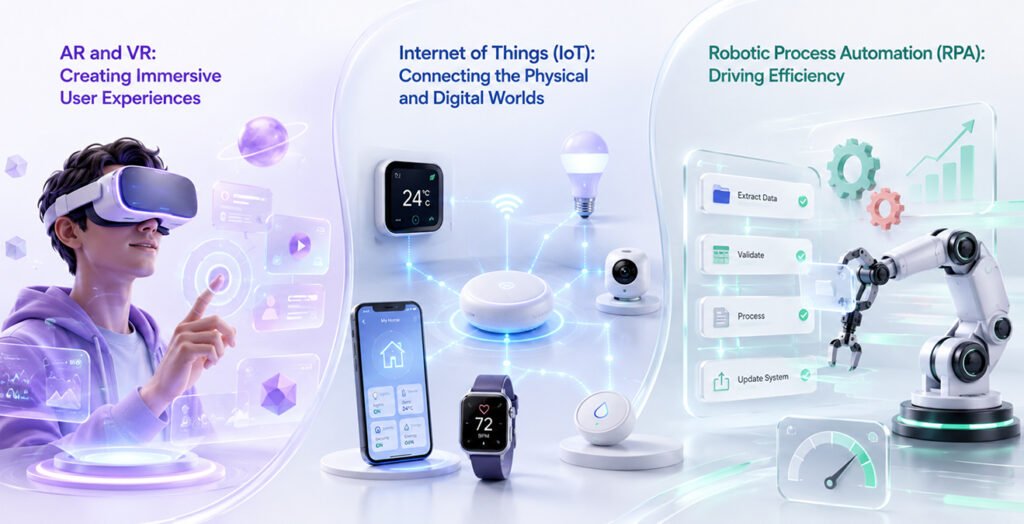
AR and VR: Creating Immersive User Experiences

Augmented Reality (AR) and Virtual Reality (VR) offer immersive experiences that transform how businesses engage with customers. Retailers use AR apps to let customers visualize products in their homes before purchase, while VR provides interactive training environments and virtual property tours in real estate.

These technologies enhance customer engagement, improve brand recall, and reduce operational costs by minimizing the need for physical prototypes or training spaces. As AR and VR become more accessible, businesses across sectors are discovering innovative ways to deliver high-impact experiences that drive satisfaction and loyalty.

Internet of Things (IoT): Connecting the Physical and Digital Worlds

The Internet of Things (IoT) links devices and systems, enabling data collection, remote monitoring, and automation. From smart homes to industrial equipment, IoT provides insights that improve efficiency and customer experiences.

In industrial applications, sensors detect equipment issues before they cause downtime. Wearable devices in healthcare track vital signs and share real-time data with medical professionals. Smart homes use IoT to optimize energy consumption and automate appliances.

IoT adoption empowers businesses to make data-driven decisions, reduce costs, and deliver personalized services, creating value for both companies and customers.

Robotic Process Automation (RPA): Driving Efficiency

RPA automates repetitive tasks, allowing employees to focus on high-value, strategic work. Finance departments use RPA for invoice processing, account reconciliation, and regulatory reporting, while HR teams streamline onboarding, payroll, and benefits management. Customer service benefits from automated responses to frequently asked questions, freeing agents to handle complex queries.

By implementing RPA, businesses can increase productivity, reduce errors, and scale operations without significantly increasing costs. RPA adoption not only improves efficiency but also enhances the overall customer experience by ensuring faster and more accurate service delivery.

Conclusion: Embracing IT Trends for Growth

The IT landscape in 2025 is defined by AI, cloud computing, cybersecurity, 5G, blockchain, edge computing, quantum computing, AR/VR, IoT, and RPA. Businesses that proactively adopt these technologies can enhance efficiency, reduce costs, improve customer experiences, and secure a competitive edge.

At Codmash, we specialize in helping businesses implement cutting-edge IT solutions tailored to their needs. Whether you’re looking to automate operations, strengthen cybersecurity, leverage cloud computing, or create immersive AR/VR experiences, our team is ready to guide you.

The future belongs to those who embrace technology strategically. Start your digital transformation journey today and unlock the full potential of the top IT trends shaping 2025.

Best AI Development Services by Codmash IT Company

Best Artificial Intelligence is no longer just a futuristic buzzword—it has become one of the most powerful drivers of business transformation in the modern digital economy. From predictive analytics to intelligent chatbots, AI is reshaping how organizations operate, communicate, and scale. At Codmash IT Company, our mission is to help businesses harness the true potential of AI by creating customized solutions that drive measurable results. Whether you are a startup looking to innovate or an established enterprise seeking operational efficiency, our AI development services are designed to give you a competitive advantage in a world where speed, intelligence, and automation define success.

The Growing Importance of AI in Business

Over the past decade, AI has evolved from being a research topic in laboratories to a mainstream business enabler. Companies across industries are leveraging AI to unlock new revenue streams, reduce operational costs, and provide personalized experiences to their customers. The pace of adoption has been so rapid that industry analysts predict AI will add trillions of dollars to the global economy in the coming years. Businesses that once relied solely on human decision-making are now blending human expertise with machine intelligence to create smarter, more agile organizations.

Custom Machine Learning Development – Codmash IT Company

Imagine a retail chain that can accurately forecast demand weeks in advance, a hospital that can detect diseases earlier than traditional methods, or a logistics firm that can optimize routes in real time. These are not distant possibilities—they are realities being powered by AI today. Codmash IT Company brings this transformative technology to businesses of all sizes, ensuring that AI is not just a tool for the future, but a practical solution for today’s challenges.

Our Approach to AI Development

AI is not a one-size-fits-all solution. Every business operates within a unique context, with its own goals, challenges, and data sources. That is why Codmash takes a tailored approach to AI development. We begin with in-depth consultation sessions to understand the needs of your organization. We then evaluate the type of data available, the infrastructure in place, and the long-term vision you want to achieve.

Once we have a clear roadmap, our team of data scientists, AI engineers, and software developers design systems that learn, adapt, and evolve over time. From building predictive models that identify future trends to creating conversational agents that deliver round-the-clock support, we focus on solutions that seamlessly integrate into your business processes. Our goal is not just to build applications, but to deliver intelligent systems that continually create value.

AI Chatbot and Virtual Assistant Solutions – Codmash IT Company

What Codmash Offers in AI Development

Codmash IT Company provides a wide spectrum of AI services, ranging from advanced machine learning models to real-time natural language processing applications. For organizations struggling with massive datasets, we develop algorithms that extract insights and turn raw information into actionable intelligence. For companies looking to improve customer engagement, we design AI-powered chatbots and virtual assistants that go beyond scripted responses, offering dynamic, human-like interactions.

We also specialize in computer vision solutions, where AI can analyze images and video streams to detect patterns, recognize objects, or enhance security. In industries like manufacturing and retail, this opens doors to automated quality checks, real-time monitoring, and smarter analytics. For enterprises with complex processes, we create robotic process automation systems that handle repetitive tasks, freeing employees to focus on higher-value work.

By combining multiple AI technologies into cohesive systems, Codmash ensures businesses are not just using AI as a supporting tool but as a strategic enabler of growth.

Industries Benefiting from AI in 2025

AI has proven its potential across nearly every sector. In healthcare, it supports doctors with predictive diagnostics and assists in drug discovery. In finance, it plays a key role in fraud detection, credit scoring, and market forecasting. Retailers use AI to personalize shopping experiences, predict demand, and optimize supply chains. Manufacturers rely on AI to maintain equipment, reduce downtime, and improve production efficiency. Even in education, AI powers adaptive learning platforms that tailor lessons to each student’s pace and ability.

Codmash works across all these industries, adapting AI technologies to the specific needs of the sector. We recognize that while the underlying technology may be similar, the challenges and opportunities vary widely. That is why every project we undertake is designed to fit the precise demands of the industry, ensuring maximum relevance and impact.

The Tangible Benefits of AI Adoption

The real value of AI lies in the tangible benefits it brings to organizations. Businesses that integrate AI into their operations often see dramatic improvements in efficiency, accuracy, and customer satisfaction. Processes that once took hours can now be completed in minutes, with fewer errors and at a fraction of the cost. Decision-making becomes more data-driven, allowing companies to act with greater confidence and agility.

Moreover, AI enables businesses to deliver personalized experiences at scale. Instead of offering generic solutions, companies can tailor products, services, and communications to individual preferences. This not only enhances customer loyalty but also drives revenue growth. For leaders focused on long-term scalability, AI provides systems that can evolve alongside the business, ensuring that growth is not limited by manual processes or outdated tools.

Why Codmash IT Company is the Right Partner

Choosing the right partner for AI development is as important as choosing the technology itself. Codmash IT Company stands out because of its commitment to building solutions that are both innovative and practical. Our team brings together expertise in machine learning, natural language processing, computer vision, and automation, backed by years of experience in delivering complex projects across multiple industries.

We do not just deploy AI models and leave them unattended. We provide continuous monitoring, retraining, and optimization to ensure that the systems we build remain accurate and effective as your business evolves. Our philosophy is rooted in collaboration, which means we work closely with your internal teams, ensuring knowledge transfer and alignment with your long-term vision. When you work with Codmash, you are not just hiring a development firm—you are partnering with a team committed to your digital future.

The Future of AI Development

The future of AI is unfolding rapidly, and businesses that adopt early are best positioned to lead. Emerging technologies like generative AI are changing how content is created, while edge AI is enabling intelligence to run on devices closer to users, reducing latency and improving efficiency. In cybersecurity, AI is becoming essential for detecting threats in real time, protecting businesses from increasingly sophisticated attacks. Ethical AI is also gaining prominence, with organizations focusing on fairness, transparency, and accountability in machine-driven decisions.

As we know, we have multiple chatbots running that are solving our daily hustle that we are facing with typing the message and finding the solutions. (e.g., ChatGPT, DeepSeek, perplexity)

Codmash IT Company stays ahead of these trends, ensuring that our clients not only adopt AI but do so in a way that is sustainable, ethical, and forward-looking. We are committed to delivering solutions that do not just solve today’s problems but also prepare businesses for tomorrow’s opportunities.

FAQs About AI Development Services

What exactly is AI development, and why is it important?

AI development refers to the process of designing and deploying systems that can learn, adapt, and make decisions with minimal human intervention. It is important because it allows businesses to scale operations, reduce costs, and provide better customer experiences.

How long does it take to implement an AI solution?

The timeline depends on the complexity of the project. Simple applications such as AI chatbots may be developed within a few weeks, while advanced predictive analytics platforms or computer vision systems may take several months.

Can small and medium-sized businesses benefit from AI?

Absolutely. AI is not limited to large enterprises. Small and medium businesses can leverage affordable AI solutions for customer support, marketing, sales, and internal process automation.

What type of data is needed to build AI systems?

AI thrives on quality data. Structured information such as transactions and sales records, along with unstructured data like emails, images, and social media posts, can all be used to train AI models.

Does Codmash provide ongoing support after deployment?

Yes. We provide monitoring, updates, and optimization to ensure that the AI systems remain effective, accurate, and aligned with business needs.

Is AI secure and compliant with regulations?

Security and compliance are integral to our approach. We design AI systems that adhere to industry standards and comply with global regulations such as GDPR and HIPAA.

View All FAQ’s

Artificial Intelligence is no longer a luxury; it is a critical driver of growth and innovation. Companies that embrace AI today are positioning themselves as leaders of tomorrow. At Codmash IT Company, we help businesses move beyond theory and into real-world applications that deliver measurable outcomes. Whether you are seeking to automate processes, enhance decision-making, or reimagine customer experiences, our AI development services are designed to transform the way you operate.

The journey to an intelligent, future-ready business starts now. Partner with Codmash IT Company, and together, we will unlock the limitless potential of AI.